If you look at a standard wedding registry or walk down the aisle of a home goods store, you’ll be bombarded by massive 18-piece knife blocks. They look incredibly professional sitting on a countertop, but let’s be honest: most of those blades spend years gathering dust. Do you really need a dedicated citrus knife, a sandwich spreader, and four different sizes of utility blades?
At Kyoku, we like to strip away the noise. Culinary mastery isn’t about how many tools you own; it’s about the quality and versatility of the ones you actually use.
If you want to clear the clutter and invest in a high-performance kitchen, you only need to own three essential knives. This “Holy Trinity” of cutlery can conquer 99% of any culinary task you throw at it.
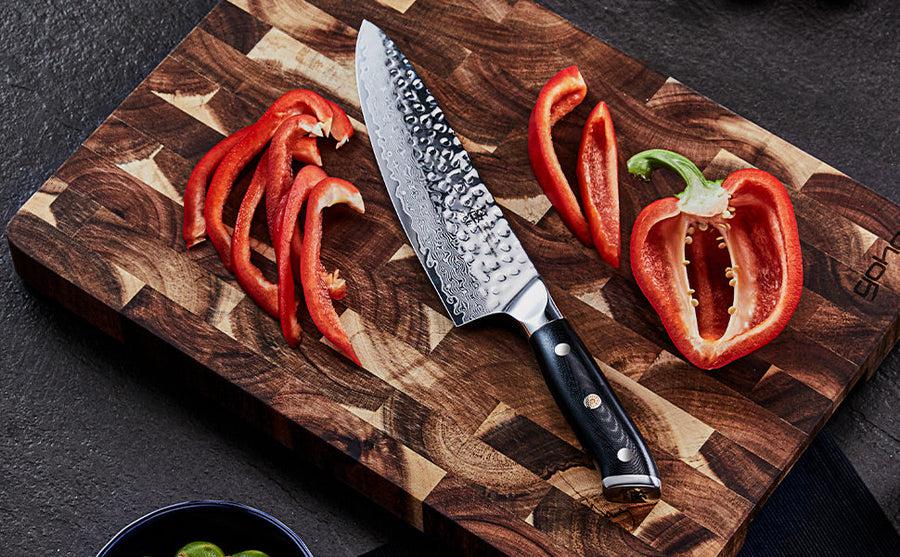
1. The Chef’s Knife or Gyuto (The Workhorse)
Primary function: Chopping, dicing, slicing large proteins, and heavy prep work.
This is the anchor of your kitchen. Whether you prefer a traditional Western Chef’s knife or the leaner, sharper Japanese Gyuto, this knife will handle roughly 80% of your cutting tasks.
- Why it’s indispensable: A good Chef’s knife (typically 8 inches in length) provides the weight, length, and leverage needed to drive through dense root vegetables, disjoint chickens, or dice mountains of onions. The gentle curve of the blade allows for a fluid rocking motion, making quick work of herbs and leafy greens.
- The pro tip: Look for a blade with a comfortable bolster. Because you’ll be holding this knife the most, the balance point should feel natural right where your thumb and index finger pinch the steel.
2. The Paring or Petty Knife (The Detail Surgeon)
Primary function: Peeling, coring, trimming, and intricate off-board work.
You wouldn’t use a broadsword to do embroidery, and you shouldn’t use an 8-inch Chef’s knife to peel an apple. The Paring knife (or its slightly larger Japanese cousin, the Petty knife) is your small-task specialist, usually measuring between 3 and 5 inches.
- Why it’s indispensable: This knife is designed for “in-the-air” or off-board tasks where the ingredient is held in your hand rather than resting on a cutting board. It’s the perfect tool for de-veining shrimp, hulling strawberries, scoring the fat on a duck breast, or mincing a single clove of garlic with surgical precision.
3. The Serrated Bread Knife (The Breaker)
Primary function: Slicing crusty bread, delicate cakes, and soft-skinned fruits.
Many people think a bread knife is a luxury, but the moment you try to slice a fresh baguette or a soft brioche loaf with a straight-edged knife, you’ll realize its value. A straight edge will crush soft bread; a serrated edge saws through it cleanly.
- Why it’s indispensable: The scalloped teeth of a serrated knife act like a saw, biting into tough surfaces without requiring downward pressure. Beyond bread, it is secretly the best tool in the kitchen for slicing ultra-ripe tomatoes, cutting clean layers out of a sponge cake, or tackling waxy-skinned fruits like watermelons and pineapples.
The Essential Trio at a Glance
| Knife Type | Typical Length | Best Used For… | What Happens If You Don’t Have It? |
| Chef’s / Gyuto | 8″ – 10″ | Onions, carrots, beef, chicken, heavy chopping | Your hands get exhausted trying to do heavy work with a small blade. |
| Paring / Petty | 3″ – 5″ | Peeling fruit, coring tomatoes, detail garnishes | You risk cutting yourself trying to do delicate work with a massive blade. |
| Serrated Bread | 8″ – 10″ | Sourdough, tomatoes, citrus, delicate cakes | You end up squishing your bread and tearing your tomatoes into a pulp. |
Quality Over Quantity
“An expensive 18-piece set of mediocre knives will dull quickly, rust easily, and frustrate your cooking. Three premium, razor-sharp blades will turn meal prep into a therapeutic ritual.”
When building your minimalist knife arsenal, prioritize materials that last. Investing in high-carbon Japanese steel (like the VG-10 cores found in our Kyoku Shogun Series) ensures that your Chef and Petty knives will hold a laser-like 15-degree edge for months of rigorous cooking.
By narrowing your focus to these three pillars, you save counter space, save money in the long run, and elevate your technique to a professional level.
If you look at your kitchen right now, which of these three essential knives is missing from your lineup, or are you currently relying on a dull supermarket alternative?